Crambe cordifolia
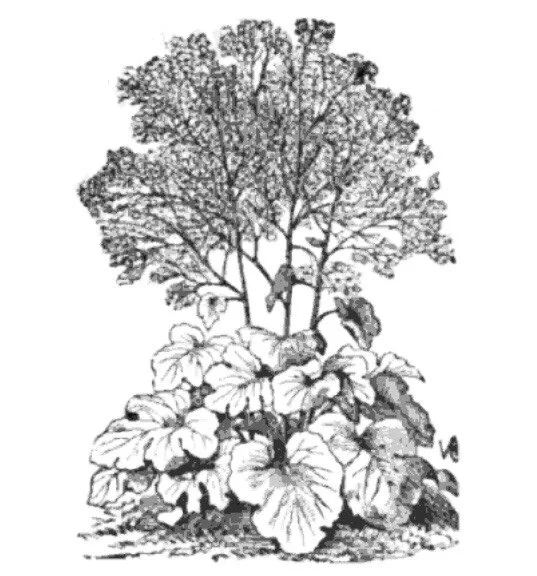
Crambe cordifolia
CRAMBE CORDIFOLIA SEEDS
Crambe cordifolia
An extraordinary hardy perennial that can grow to massive proportions in deep fertile soils. The basal foliage can grow to a breadth of 5', with individual leaves around 1' each. In the second and most subsequent summers the plant throws up one or more massive stalks topped with a huge ploom of tiny white flowers not unlike those of Baby's Breath on long branched panicles that can span 6' or more. In the loess of Iowa the flowering stalks grew to nearly 8' tall, although it is more often around 5' in typical garden culture. It is a spectacular plant, singular in form, and even marginally edible.
Historic garden literature is filled with accounts bewilderment at the habit of this species, which is peculiar to say the least. The seeds require stratification to germinate, and the plants began in pots can be quite meager and inconspicuous in the first year following transplant. The second year sees a huge mass of foliage that the unsuspecting gardener might not expect nor know what to do with as it crowds out its garden companions. And the plant in bloom is almost perverse in size, archaic even, as one can easily imagine it more appropriate amongst the megafauna of the pleistocene than in our humble holocene landscapes.
Directly sown seeds typically see hastened growth in the first year and more reliable bloom in the second. The seeds can be sown in situ in the autumn and will begin to germinate during the first warm days of late winter and early spring. They may also be sown into deep pots of soil overwintered outdoors in a sheltered location. Germinated seeds should be pricked out promptly to grow on in individual large pots, or better yet in the garden for most reliable performance and bloom in the second year. Crambe cordifolia prefers full sun but will tolerate some late day shade. Considerable attention should be paid to drainage in damp regions lest the crowns rot.
As with all Crambe species, deep rich well-drained soils are ideal. Performance will be hampered in clay and in shallow soils, although this might be preferable if space is limited. Potential companions are few and far between, and are primarily foliage plants or herbaceous shrubs. To truly appreciate this plant the gardener must accept it as an odd loner that will never fit in. It has no peer, and is unique even within its own genera.
Listed in most historical literature as native to the Caucasus and Himalayas where the tender spring foliage is valued as a potherb and the roots eaten as a cooked vegetable. Hardy to at least zone 5 given drainage.
Packet contains at least 10 seeds.