Skirret
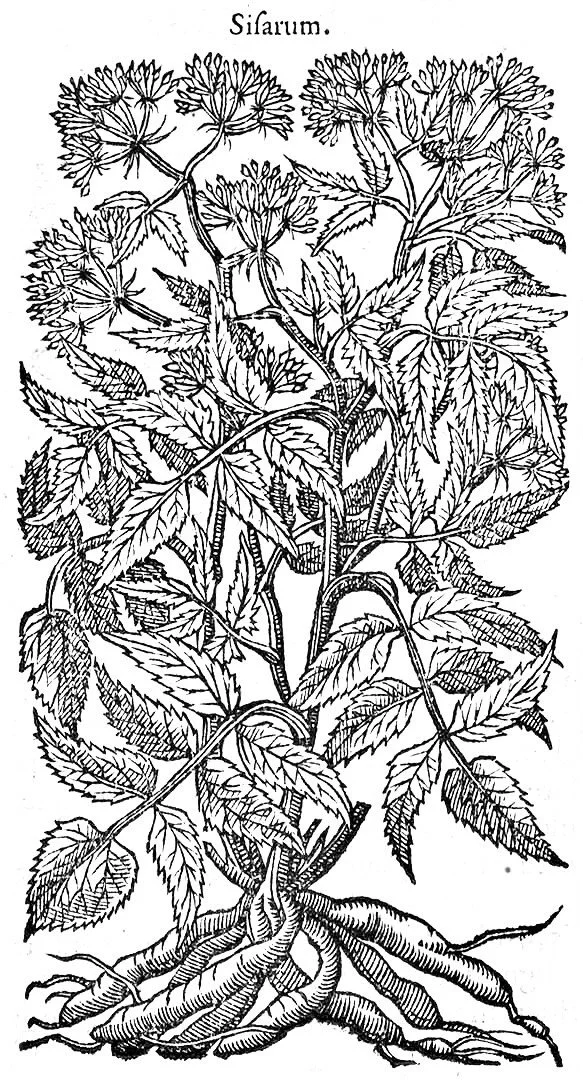
Skirret
SKIRRET SEEDS
Sium sisarum
One of the most peculiar of ancient vegetables. Still misrepresented as being Chinese, this species is not documented to have ever been foraged nor cultivated in eastern Asia prior to its introduction from Europe. It is more likely native to the Altai region of Siberia. In 1884, Polish botanist Rostafiński wrote that it could be found growing wild in parts of Ukraine. Thus, Skirret is perhaps more accurately characterized as Scythian! Regardless of its origin, it has fallen into even greater obscurity in the past century, having been usurped by the parsnip, which is indeed a similar and utterly superior vegetable.
Skirret was commonly cultivated in European gardens throughout the 16th and 17th centuries. Though the top growth is unremarkable and inedible, the many pencil-thin white roots are anise-scented and sugary-sweet and available to eat in the hunger gap of early spring. The name for Skirret in German is “zuckerwurzel", which is literally “sugar root". And though they are indeed pleasant to taste, their exhumation and preparation is exhausting as compared to modern selections of root vegetables, save for perhaps Black Salsify.
Like many untamed Umbelliferae the seeds prefer to germinate at cool temperatures. The best germination is achieved by sowing seeds into pots of moist soil and placing outdoors in a sheltered location in late winter. Seeds will germinate slowly but reliably as days warm and nights remain cold. To sow indoors: press seeds into moist soil, barely covering with fine vermiculite and mist generously. Cover with plastic to maintain moisture. Kept at around 50°-65°F in bright indirect light, seeds will begin to germinate in about three weeks. They may take much longer. Simulation of conditions spent outdoors in early spring is ideal. Do not use heat. Promptly transplant seedlings with true leaves into deep pots of moist fertile soil to grow on at room temperature in bright light. Water frequently. Harden off before transplanting outdoors into moist fertile soil in spring. Potted plants may also be transplanted in autumn.
This species prefers to grow in consistently moist fertile soil. It's a great plant for boggy bottomland in full sun, so long as there are no cloven-hoofed animals nearby, because they will eat these plants to the ground. Hardy to zone 5. Roots are sweetest in the cold of late autumn, winter and very early spring. Wait to harvest new plantings until at least the second autumn.
Packet contains at least 30 seeds.